
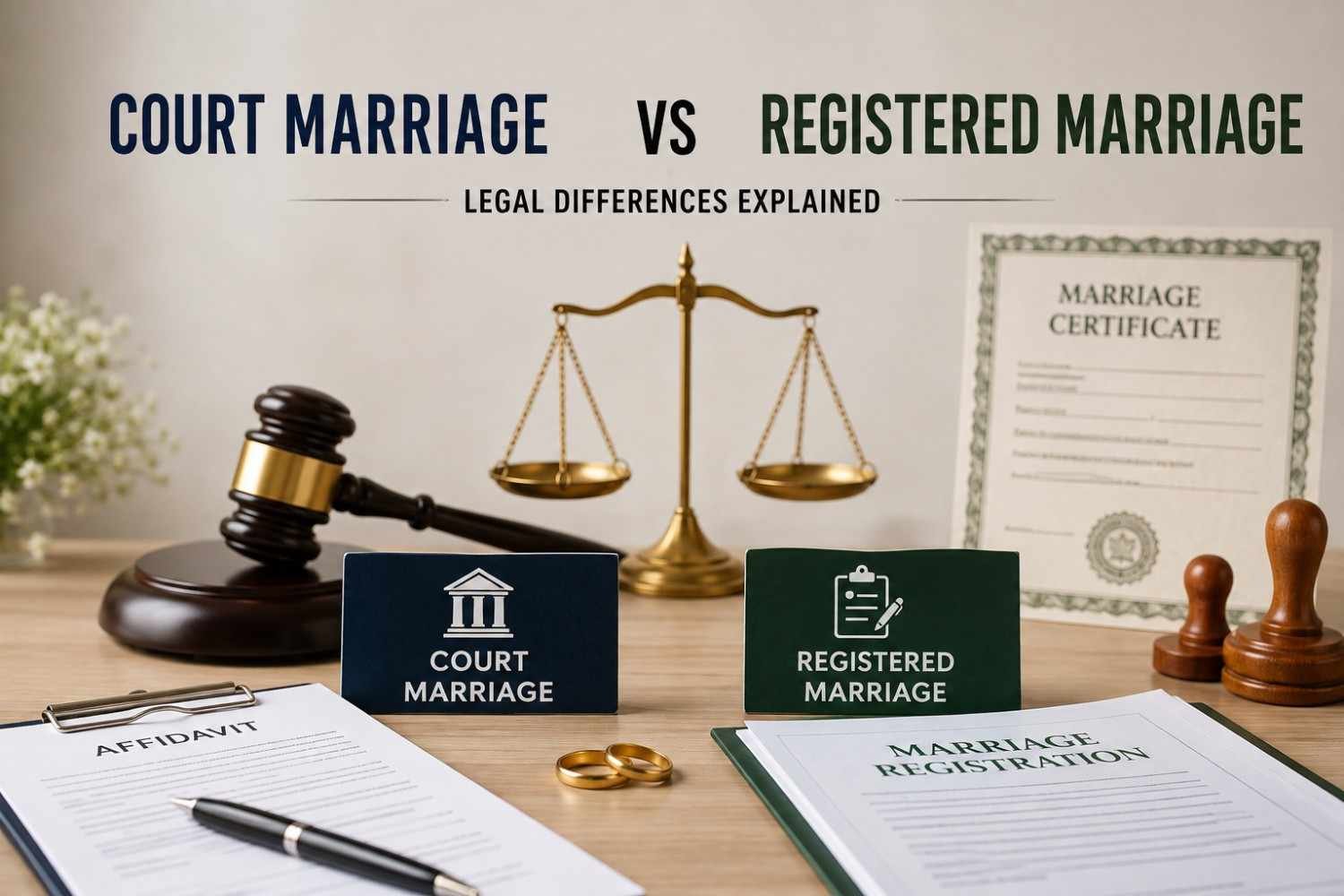
Marriage is an important legal and social institution, and couples in India often come across two terms: court marriage and registered marriage. Although both provide legal recognition to a marriage, they are not exactly the same. Understanding the difference can help couples choose the right procedure and prepare the required documents.
In this guide, Advocate Chirag Arora explains the key differences between court marriage and registered marriage, including the procedure, legal requirements, documents, and practical considerations.
What Is Court Marriage?
Court marriage is a legal marriage performed directly before a Marriage Officer under the applicable marriage law, commonly the Special Marriage Act, 1954. It allows eligible couples to marry without requiring a traditional religious ceremony.
The court marriage process in India generally involves submitting a marriage notice to the Marriage Officer, completing the required notice period, verification, and appearing before the Marriage Officer with witnesses. Once the legal formalities are completed, the marriage certificate is issued.
Court marriage can be particularly suitable for couples who want a civil marriage without following a religious ceremony.
What Is Registered Marriage?
A registered marriage generally refers to the legal registration of a marriage that has already been solemnized through a religious or customary ceremony. Depending on the circumstances and applicable law, the couple can apply to the relevant Marriage Registrar for registration and obtain an official marriage certificate.
The registered marriage process usually involves submitting an application, providing identity and address documents, presenting proof of the marriage ceremony, verification by the authorities, and completing the registration formalities.
Therefore, registration does not necessarily mean that the couple is getting married at the registrar's office for the first time. In many cases, the marriage has already taken place and is subsequently recorded officially.
Court Marriage vs Registered Marriage: Key Difference
The most important distinction in court marriage vs registered marriage is the stage at which legal registration takes place.
In a court marriage, the marriage itself is solemnized before the Marriage Officer according to the applicable legal procedure. In a registered marriage, the marriage may have already been solemnized through a customary or religious ceremony and is subsequently registered with the competent authority.
This comparison shows why understanding the difference between court and registered marriage is important before starting the legal process.
Court Marriage Legal Requirements
Couples considering court marriage should understand the applicable eligibility conditions and procedural requirements. Under the Special Marriage Act, the parties must generally satisfy statutory conditions relating to age, existing marital status, prohibited relationships, and mental capacity.
The court marriage legal requirements may also include giving notice to the Marriage Officer, waiting for the legally prescribed period, addressing any objections according to law, and appearing with witnesses for solemnization.
Because requirements and procedures can vary depending on the circumstances and jurisdiction, couples should verify the current requirements with the relevant Marriage Officer or a qualified legal professional.
Marriage Registration Documents in India
Proper documentation is an important part of both marriage registration and court marriage procedures. Commonly requested marriage registration documents in India may include:
Identity and age proof of both parties
Address proof
Passport-size photographs
Proof of marital status, where applicable
Affidavits or declarations required under the applicable procedure
Witness identity and address documents
Proof of marriage ceremony for registration of an already solemnized marriage
Divorce decree or death certificate of a previous spouse, where applicable
The exact documentation can vary based on the applicable law, state rules, and individual circumstances.
Which Option Should You Choose?
The right option depends on the couple's circumstances. If a couple wants to solemnize a civil marriage without a religious ceremony, court marriage may be appropriate. If the couple has already completed a traditional marriage ceremony and wants official legal documentation, marriage registration may be more suitable.
Before choosing between court marriage vs registered marriage, it is advisable to understand the applicable law, documentation, notice requirements, and local registration procedure.
Why Legal Guidance Can Help
When it comes to the legal side of marriage, there’s paperwork, statutory requirements, and all those government formalities. And if there’s even a small misstep in the application or some incomplete document, it can end up with delays, kind of unneeded really. It’s like everything has to line up just right; otherwise the whole process drags on.
Talking with a qualified legal professional can help couples figure out their rights and responsibilities more clearly, locate the right procedure, and get all the papers ready the correct way. Advocate Chirag Arora can offer legal guidance around marriage procedures and also other family-law concerns.
For individuals looking for the Best advocate in Delhi, professional guidance can make the legal process easier to understand and manage. Similarly, those dealing with separation-related matters can seek appropriate guidance from a Mutual Divorce advocate in Delhi.
Final Thoughts
Figuring out the difference between court marriage and registered marriage is kinda essential for couples who are planning to formalize things legally. Court marriage usually means the ceremony is done before the Marriage Officer, so it’s solemnized there. Registered marriage, on the other hand, tends to mean that the marriage has already happened and then it’s later officially entered into the records, like a formal acknowledgment.
The applicable procedure, documents, notice requirements, and eligibility conditions can differ depending on the circumstances and governing law. Therefore, before proceeding, couples should carefully verify the requirements applicable to their case.
If you’re sort of confused about court marriage vs registered marriage, getting professional legal guidance can help you, piece by piece, grasp the right path and wrap up the required formalities with more confidence.