
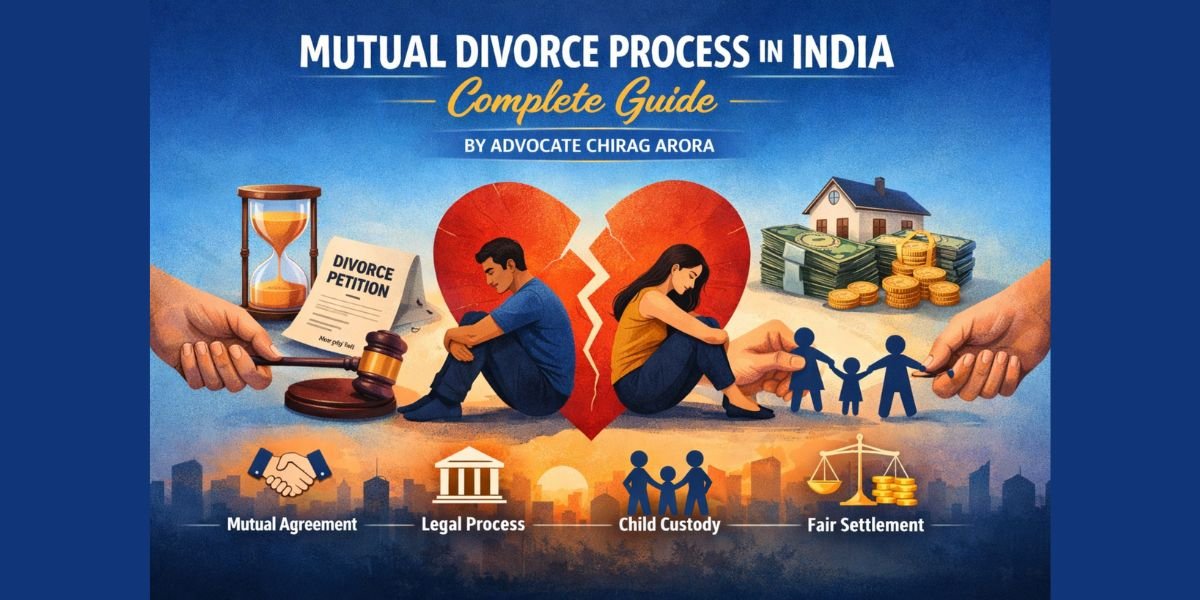
Marriage, though a beautiful union, sometimes stops serving the happiness and purpose it once did. When two people decide to separate amicably, the law provides a dignified way to end the relationship, divorce by mutual consent. The mutual divorce process in India offers couples an efficient, respectful, and cost-effective solution to legally part ways without courtroom hostilities.
At Advocate Chirag Arora’s firm in Tis Hazari, Delhi, we’ve handled hundreds of Family Court divorce cases involving couples who simply wanted closure with minimal emotional strain. This guide explains every layer of the mutual divorce process, the documentation, timeline, and benefits, making it simpler to navigate this crucial life decision with clarity and confidence.
What is Mutual Consent Divorce?
Under Divorce in India, when both spouses mutually agree that their marriage has irretrievably broken down, they can file for a mutual consent divorce. Section 13B of the Hindu Marriage Act, 1955, allows partners to legally separate through the mutual divorce procedure in India if certain conditions are satisfied.
This provision embodies maturity; it gives couples the legal space to end the marriage without assigning fault. Similar rights exist under Section 28 of the Special Marriage Act, 1954, and Section 10A of the Divorce Act, 1869, for other faiths. The essence remains the same: two people decide, by consent, that peaceful marriage dissolution is in their best interest.
Unlike a contested divorce, the mutual divorce process reduces conflict, preserves dignity, and limits exposure to public scrutiny.
Legal Conditions for Filing a Mutual Divorce in India
Before filing for a mutual divorce, the Indian divorce law sets certain conditions. Each requirement ensures that both parties act willingly, preventing misuse or hasty decisions leading to regret.
Minimum One-Year Marriage and Separation
The couple must be married for at least one year, and the spouses should have lived separately for over a year before petitioning.
Voluntary and Mutual Agreement
Both parties must genuinely and voluntarily consent to the divorce. The law emphasises free will—no coercion, fraud, or undue pressure is allowed. A clear mutual divorce agreement helps communicate this consent transparently.
No Coercion or Fraud
Free consent is the soul of the process. Statements recorded in the Family Court during the divorce petition proceedings ensure authenticity.
As Advocate Chirag Arora explains, when the conditions are fulfilled, the mutual divorce process becomes smooth, quick, and legally secure.
Step-by-Step Mutual Divorce Procedure in India
The step-by-step mutual divorce procedure runs through five key stages before the Family Court:
Step 1 – Filing the Joint Divorce Petition
Both spouses jointly file a divorce petition before the appropriate Family Court with jurisdiction where they last lived together, or where their marriage was solemnised. This petition comprises all details about marriage, separation, and agreed terms on child custody, maintenance, and property.
Step 2 – First Motion and Statement Recording
Once filed, both parties appear before the judge, confirming their mutual consent. Their statements are recorded, and the judge may recommend counselling or mediation, part of the family dispute resolution mechanism.
Step 3 – Cooling-Off Period
A mandatory six-month waiting period follows to allow for reconciliation. However, the Court Process allows waiver of this period if waiting serves no meaningful purpose and the marriage is beyond repair.
Step 4 – Second Motion and Final Hearing
After six months (or sooner if waived), the couple reaffirms their consent. The court then reviews the settlement and verifies that all agreements were voluntary and fair.
Step 5 – Decree of Divorce
Once satisfied, the Family Court issues a decree of marriage dissolution, legally concluding the bond. This marks the end of the Marriage Dissolution Procedure.
For accurate execution, partnering with a seasoned mutual divorce advocate in Delhi ensures each document and timeline is perfectly managed.
Essential Documents Required for Mutual Divorce in India
Proper documentation is vital for a seamless mutual divorce procedure in India. The legal documents for divorce include:
Marriage certificate proving the relationship’s validity under the Divorce Act under Indian Law.
Address and identity proofs of both parties for jurisdiction clarity.
Photographs of the couple for case identification.
Proof of separation, like lease copies or witness attestations.
Income or property details relevant for maintenance discussions.
Mutual divorce papers are a compiled set, including the mutual divorce form and mutual divorce agreement signed by both parties.
Each of these legal documents demonstrates preparedness and transparency, reducing the chances of technical delays.
Timeline for Completing a Mutual Divorce in India
Ordinarily, the mutual divorce process in India spans between six months and eighteen months. The initial motion, the cooling-off period, and the final hearing constitute this timeline.
However, recent judicial precedents allow the court to waive the cooling-off period if reconciliation isn’t possible. A competent mutual divorce lawyer in Delhi, such as Advocate Chirag Arora, can skillfully request this waiver, helping the spouses finalise the process efficiently.
Child Custody and Alimony in Mutual Consent Divorce
During the divorce, issues such as child custody, visitation rights, and financial support must be mutually settled. Courts always prioritise the child’s welfare.
Both parents can agree on joint custody, sole custody, or visitation arrangements in their mutual divorce agreement. Similarly, alimony or maintenance—either as a lump sum or a monthly payment—is decided by consensus.
The Family Court evaluates these terms, confirming they’re fair to all parties and, especially, beneficial for the child’s development and emotional security.
Key Benefits of Choosing Mutual Consent Divorce
Choosing a mutual consent divorce offers several key advantages under Indian divorce law:
Speed and Simplicity: The mutual divorce process resolves matters faster than contested litigation, often within a year.
Emotional Ease: Since both sides agree, proceedings happen calmly, minimising confrontation and protecting everyone’s mental well-being.
Reduced Legal Costs: Shared representation and less paperwork mean the process is wallet-friendly.
Privacy and Dignity: Hearings and settlements remain discreet, preserving reputations.
Child Welfare Focus: Parents can cooperatively settle custody, minimising psychological strain on children.
Advocate Chirag Arora, an experienced mutual divorce advocate, notes that mutual consent divorces offer couples the rare benefit of closure without hostility, a legal pathway emphasising respect over resentment.
Common Mistakes to Avoid During the Mutual Divorce Process
Even peaceful separations require careful legal attention. Ensure you avoid these mistakes during your mutual divorce process:
Failing to document terms clearly can cause post-divorce disputes. The mutual divorce papers and memorandum of understanding must outline key aspects of custody, alimony, and property.
Rushing into unfair settlements under emotional stress may backfire. Always have your clauses reviewed by the best mutual divorce lawyer in Delhi.
Ignoring procedural guidelines, such as the proper divorce procedure in India, can lead to petition rejections. To prevent that, rely on experienced professionals who manage every procedural nuance from petition submissions to decree certification.
How to Simplify the Mutual Divorce Procedure in India
Thanks to evolving legal-tech practices, managing a mutual divorce process in India has become more transparent and less time-consuming. Online filing, digital documentation, and telephonic consultations now make the process client-friendly.
At our firm, Advocate Chirag Arora ensures complete confidentiality and precision during every step of divorce filing. Personal data is always treated as strictly confidential, maintaining trust as the foundation of our practice.
Our mission is simple: To make the legal process humane, efficient, and solution-oriented.
Why Hire an Experienced Mutual Divorce Lawyer in Delhi
When emotions run high, sound legal guidance provides calm. Partnering with the right lawyer makes all the difference.
As one of Delhi’s reputed professionals, Advocate Chirag Arora holds vast experience in handling Family Court divorce cases and delivering holistic legal services for divorce. Being both empathetic and efficient, he is recognised as the best mutual divorce lawyer in Delhi, trusted for balanced advocacy and problem-solving.
Choosing a mutual divorce advocate in Delhi ensures compliance with every procedural requirement, allowing you to focus on rebuilding your life while your lawyer manages the legal complexities.
Expert Insights on Divorce Laws in India
Divorce under Indian law balances individual liberty with marital responsibility. The courts, through the Family Court framework, seek to protect fairness and promote amicable resolutions wherever possible.
The mutual divorce process aligns with the spirit of this legal philosophy; it enables Family Dispute Resolution through cooperation instead of conflict. Each Divorce petition under the process symbolises two individuals parting ways respectfully while maintaining the integrity of law and personal dignity.
As Advocate Chirag Arora often shares, “A well-conducted mutual divorce doesn’t mean failure; it represents both maturity and respect for one another.” Conclusion: A Respectful and Smooth Mutual Divorce Process
The mutual divorce process in India stands out as a progressive mechanism that harmonises law, compassion, and closure. It minimises emotional trauma, reduces costs, and secures fairness all without endless litigation.
By understanding legal requirements, preparing thorough legal documents for divorce, and securing representation from a seasoned professional, you can complete this journey smoothly and confidently.
For precise guidance and dependable assistance in navigating the mutual divorce process, reach out to Advocate Chirag Arora, the best mutual divorce lawyer in Delhi.
Visit our Google Business Profile or connect with our office at Tis Hazari for a confidential consultation today and start your path toward a peaceful, clear, and lawful new beginning.