
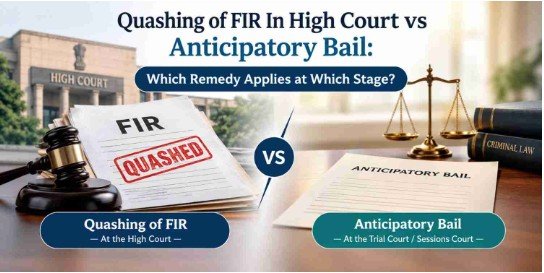
When a person is named in an FIR and is concerned about possible arrest or criminal proceedings, two legal remedies often come into discussion: FIR quashing vs anticipatory bail. Although both may be considered in criminal matters, they serve very different purposes. One primarily challenges the continuation of criminal proceedings, while the other seeks protection from arrest.
For any individual who has opted for Quashing of FIR in Delhi High Court , it becomes essential to differentiate between these two remedies before proceeding. Advocate Chirag Arora can help an individual get aware of the proceedings stage, legal remedy, and other circumstances that are associated with the case.
What Is Anticipatory Bail?
Anticipatory Bail is a kind of safeguard before an arrest. According to Section 482 of Bharatiya Nagarik Suraksha Sanhita (BNSS), if someone has any cause to fear his arrest in respect of a non-bailable offense, he may move the High Court or Court of Sessions for necessary relief.
The purpose is not to cancel the FIR or end the criminal case. Instead, it concerns protection from arrest, subject to the conditions imposed by the court.
When Can Anticipatory Bail Be Considered?
Anticipatory bail may become relevant when:
An FIR or criminal complaint has created a genuine apprehension of arrest.
The alleged offence is non-bailable.
The person wants protection before being taken into custody.
The facts and circumstances support consideration of pre-arrest bail.
Also Read: When Do You Need Legal Help to Get an FIR Cancelled?
The court may impose conditions while granting such relief, depending on the circumstances of the case.
What Is FIR Quashing in the High Court?
FIR quashing is different from bail. The High Court has inherent powers under Section 528 of the BNSS to make appropriate orders to prevent abuse of the process of a court or otherwise secure the ends of justice.
A petition seeking quashing may challenge the FIR or subsequent criminal proceedings on legally recognised grounds. The High Court examines the material and circumstances of the particular matter before deciding whether its inherent jurisdiction should be exercised.
When Can FIR Quashing Be Sought?
A person may consider this remedy where there are legally sustainable grounds for challenging the continuation of the criminal proceedings. The exact grounds depend on the allegations, available material, procedural history, and circumstances of the case.
Advocate Chirag Arora can examine the facts and explain whether a petition for quashing of FIR in High Court may be legally maintainable in the circumstances. FIR Quashing vs Anticipatory Bail: Key Differences This distinction is important because FIR quashing vs bail involves two different legal questions. A person should not assume that obtaining one remedy automatically provides the other. Which Remedy Applies at Which Stage?
The stage of the criminal matter can be important when considering quashing FIR or anticipatory bail.
If the immediate concern is a genuine apprehension of arrest, anticipatory bail may be the relevant remedy. If the concern is the continuation of an FIR or criminal proceedings and there are recognised legal grounds for challenging them, a High Court quashing petition may be considered.
Therefore, anticipatory bail vs FIR quashing is not simply a choice between two alternative forms of bail. They address different legal objectives.
The Supreme Court has also dealt with situations where applications for anticipatory bail and petitions seeking quashing arise in the same criminal matter, showing why the procedural history and relief being sought need to be examined separately.
Can FIR Quashing and Anticipatory Bail Be Sought in the Same Matter?
Yes, circumstances can arise where both remedies become relevant in the same criminal matter. However, they are separate proceedings seeking different forms of relief.
For example, a person may have grounds to challenge the continuation of an FIR while also facing an apprehension of arrest. Whether both remedies should be pursued, and at what stage, depends on the facts, allegations, investigation status, and applicable law.
DELHI HIGH COURT FIR QUASHING matters therefore require careful examination of the FIR, relevant documents, investigation stage, and the relief being requested.
What Factors Should Be Considered?
Before taking legal action, it is useful to consider:
Stage of investigation: Whether the investigation is at an early stage or has progressed further.
Nature of allegations: The specific offences and allegations mentioned in the FIR.
Arrest apprehension: Whether there is a genuine concern about arrest.
Grounds for quashing: Whether there are legally recognised grounds for challenging the proceedings.
Available material: FIR, statements, documents, communications, and other relevant evidence.
Procedural history: Any previous bail application, court order, investigation development, or related proceeding.
A proper review of these factors can help clarify whether the issue concerns protection from arrest, challenge to the criminal proceedings, or potentially both.
Conclusion
The difference between quashing of FIR vs anticipatory bail mainly lies in the relief each remedy seeks. Anticipatory bail is concerned with protection from arrest, whereas FIR quashing involves the High Court's jurisdiction to consider whether criminal proceedings should be allowed to continue in the circumstances of the case.
Advocate Chirag Arora can help you analyze the FIR, procedure, and documents to provide guidance about possible legal remedies. In case you have an FIR and you are in confusion whether to file for anticipatory bail or quash the FIR in High Court, then legal consultation in this respect can help you take the next step.
For assistance with your criminal matter, Contact Advocate Chirag Arora to discuss your case and understand the applicable legal procedure.