
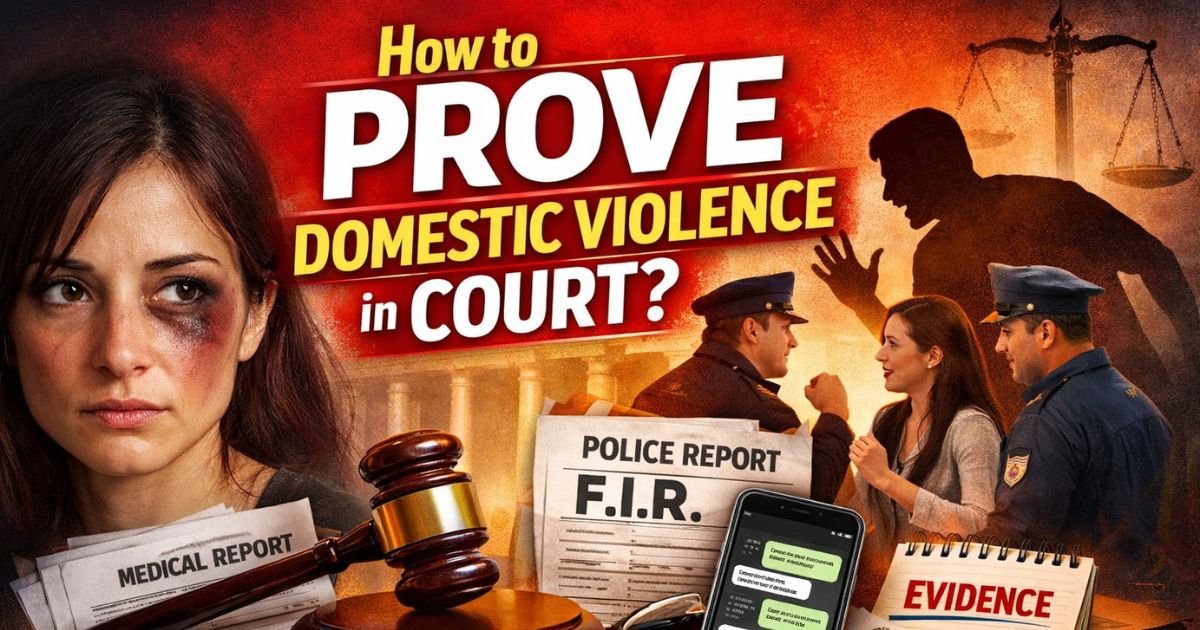
Being abused in your own home is terrifying and takes a lot of bravery to stand up to. When a survivor chooses to come forward and pursue justice, knowledge of the law provides the first layer of protection. In the courts, how solid a claim is is usually dependent on the evidence submitted to the judge. The key to success in any domestic violence claim is the strength and integrity of the evidence obtained. To deal with the intricacies of domestic violence/abuse legislation, you require not just strong emotional stamina, but you also need a tactical mind when it comes to evidence collection. Whether you're heading to family court or criminal court, the documents you submit can make or break your case. Advocate Chirag Arora said, these are sensitive issues, but - while the law is a protector - it is very evidence-driven to establish allegations and deliver justice.
Understanding Domestic Violence Law in India
The legal provision in place for the Protection of Women from Domestic Violence Act (PWDVA) in India is very comprehensive. The Act also extends civil remedies to women suffering from abuse in their matrimonial homes or in joint family arrangements. To apply this law, you need to know what the law is in India about domestic violence and what constitutes abuse therein. It is not about physical pain; it is about verbal, emotional, sexual, and financial abuse as well. It is important to remember when drafting a domestic violence case that the complainant has the onus of proof. So yes, you need domestic violence proof. The domestic violence act provides proof that the relationship existed and that the abuse occurred in a shared household. The secret of how to prove domestic violence in India lies in the scrupulous gathering of materials that will stand scrutiny in the Indian Courts, so that your story of abuse is supported by incontestable facts.
Essential Types of Domestic Violence Evidence
The most clear-cut form of evidence generally comes from instances of bodily injury. The physical abuse( documentation) , much of the time, is the strongest evidence of domestic violence, because it is visible or requires medical attention. Pictures of injuries, ripped clothing, or broken items of home can be very compelling visual aids in court. They are also critical that medical documentation be provided for those cases of domestic violence. If, after an incident, you have been to a hospital or a clinic, discharge summaries, the prescription, and the observations of the doctor come to form part of the evidence in the case of domestic violence. "The report must indicate explicitly that the injuries were caused by assault/dispute at home and not by an accident". These reports connect an allegation to a confirmed fact, presenting an objective account of the abuse the victim has endured to the court.
Documenting Non-Physical Abuse
Demonstrating abuse that causes no physical marks can be difficult, but it is just as necessary under the PWDVA. Proofs of emotional abuse are also usually based on patterns of behaviour and are not simply drawn from isolated incidents. Technology is now a big player in domestic abuse evidence in the age of digital. Stored texts, emails, call recordings, and social media exchanges can show harassment, threats,s or bullying. Advocate Chirag Arora often counsels clients to keep a detailed diary or logof incidentst, including mention of dates, times, and particulars of verbal abuse or economic denial. This contumacious record may also be introduced as a piece of domestic violence to evidence an enduring climate of animus. When you are collecting evidence of domestic violence, you should also take advantage of the power of digital footprints; you may just find that they capture the psychological warfare at the heart of a toxic relationship.
The Role of Official Reports and Witnesses
Among the most important steps in putting a complaint on formal record is to get the police involved. A domestic violence police report (or a General Diary (GD) if not in a position to file a report) is usually the first documentation of the abuse. Although not all complainants immediately rush to put a First Information Report (FIR) under Section 498A of the Indian Penal Code on record, a report with the police already gives the impression that the victim did seek assistance. This police record is a very critical piece of domestic violence legal proof in India. Also, in domestic violence cases, witnesses to the abuse can be neighbours, friends, or family members who have witnessed or heard the abuse. They confirm the victim's narrative. In instances where the police may have filed a Domestic Incident Report (DIR), that report becomes a keystone within the evidentiary requirements of the PWDVA. The blend of official police documents and admissible witness testimony provides a full-layered protection for the victim.
Domestic Violence in a Toxic Marriage
The effects of abuse are often felt in divorce proceedings as well. Domestic violence in a toxic marriage is the foremost ground for filing for separation or divorce. Abuse changes the entire legal approach for ending a marriage, and that is true whether one spouse is abusive or both are. The general perception is that when Indian divorce law lets you ask for divorce on grounds of cruelty, it is referring to physical and mental cruelty,y including domestic violence. Established domestic violence is cruel and rests on a proven ground for divorce. So the domestic violence proof you gather for a protection order is just as potent in a divorce petition. Family lawyers for domestic violence – Domestic violence is an issue that crosses over the family as well asthe crime aspect of the law, and for clients that wish to end a destructive relationship, they often need family law attorneys for domestic violence who can handle the criminal and civil sides of their case. The crossover between divorce law and protection laws means that proof introduced in a Magistrate's Court to obtain immediate protection can also be used in a Family Court to finalise a divorce.
Legal Procedures and Court Requirements
The domestic violence legal process in India usually starts with the filing of an application under Section 12 PWDV before the Magistrate. This application needs to be accompanied by an affidavit andthe necessary proof of domestic violence in India. Section 12 Domestic Violence case allows the court to issue a Protection order, Ra esidence order, and Monetary relief. To obtain these orders, the evidence in a domestic violence case in India has to be lucid. Advocate Chirag Arora makes sure that every evidence from medical slips to police complaints is in place to establish the case as per the stringent evidentiary requirements of the CrPC, which governs these proceedings. What you need to know about the domestic violence court evidence India demands. To avoid a delay in procedures and get immediate safety for the woman suffering from abuse, procedures as mentioned above must be followed.
When to Consult a Lawyer for Domestic Violence
Knowing when to seek help US is a crucial point in the journey of a survivor of abuse. When to Get a lawyer for domestic violence: What You Need to Know Can Help You Know When You Need Help. Consulting a legal professional in DV cases can mean the difference between enduring harm and receiving protection. Early advice can help to ensure that evidence is preserved, which might otherwise be lost. For capital dwellers, hiring a good lawyer in the Tis Hazari Court is a necessity, considering the importance of the court. As a wide-ranging Advocate at Tis Hazari Court, Delhi, I can handle your appeal from beginning to end, including the local procedural aspects. From the best Tis Hazari Court lawyer tothe initial consultation, professional representation will ensure that your voice is heard. Advocate Chirag Arora provides you with the required legal guidance to sail through these rough waters, directing that the domestic violence evidence is exploited to the fullest for obtaining the most favourable orders.
Finding the Right Legal Support
A case is never the same after choosing a lawyer you do not trust. You need a Tis Hazari Court lawyer who knows everything about family as well as criminal law. If you are charged with criminal charges, then you need a criminal lawyer in Tis Hazari Court to deal with bail and trial proceedings. The top criminal lawyer in Tis Hazari Court will know how to cross-examine witnesses and undermine the version of the defence. On the other hand, if you are accused of fabricated allegations, a criminal counsel in the Tis Hazari court is a must to have. A proficient Criminal lawyer at the Tis Hazari Court can also extend help in case there are cross-cases lodged. For victims," he added, "just making sure that your lawyer understands the complexities of domestic violence evidence is key. Be it a divorce lawyer in Delhi or a professional in protection orders, the objective is to put forth a case that the judiciary finds convincing enough.
Criminal Proceedings and FIRs
And, in much disrespect, the abuse may be made a punishable offence under the Indian Penal Code (IPC). This usually starts with the filing of an FIR. But the legal process can be difficult , and there are cases where a false FIR is filed in retaliation. In such cases, it is recommended to have the best lawyer for FIR quashing. Quashing of FIR in Delhi High Court is a plea ofa special nature in which the court can quash the proceedings as an abuse of the process of law. This just goes to show that blowing the whistle on DV needs to have credible proof, or else the case can be tossed out. Conversely, if you're the complainant, you've got to have hard evidence to keep your FIR alive. A divorce lawyer at Tis Hazari Court, Delhi, who can appreciate the criminal overlay is a must here. They serve not only as a Divorce lawyer at the Tis Hazari Court but also as afull-fledgedd legal guardian.
Securing Your Future with Strong Representation
Legal redressal aims at ensuring a safe and dignified future. A Family lawyer in Tis Hazari will represent you in the civil court for your rights and entitlements relating to custody, alimony, and right of residence, in addition to related domestic violence cases. Advocate Chirag Arora is a Tis Hazari Court-based family Advocate who is committed to comprehensive settlement in family matters. The proof of domestic violence you provide will be taken into account when considering matters such as child custody or financial support. If the surroundings are not safe, a criminal lawyer in Tis Hazari Court can even help in shifting the case to some other jurisdiction if the life of the victim is in danger. Each stage of the domestic violence legal proof in India is created in such a way as to make the victim self-reliant; however, it need specialist's hand to expert these Legal tools.
Conclusion
Proving abuse in a court of law is a rigorous process that demands attention to detail and a thorough understanding of the law. From collecting medical records to domestic violence to securing witness testimonies, every piece of domestic violence evidence serves as a building block for justice. The journey from being a victim to a survivor is fraught with challenges, but the Indian legal system provides powerful avenues for relief under the PWDVA and IPC. With the guidance of Advocate Chirag Arora, you can navigate the corridors of the Family Court and Magistrate Court with confidence. Whether you need a Legal consultation at Tis Hazari, comprehensive Legal services in Tis Hazari Court, or are simply searching for a Lawyer near Tis Hazari Court, taking that first step towards professional advice is crucial. Do not let the lack of information deter you; gather your evidence, know your rights, and seek the justice you deserve.